
A custom fireplace glass door installed in Chicago and the surrounding suburbs lands between roughly $1,800 and $4,000+, depending on the door line you pick, the size of your fireplace opening, the finish, and whether your fireplace takes an overlap door or requires a mortar-in install. Fireplace glass doors cost in Chicago varies more by selection than almost any other product we sell at Fireplace & Chimney Authority — but the three tiers below cover the realistic range for nearly every project that comes through our Lisle and Elmhurst showrooms. Most of the doors we install go into homes across DuPage County and the western suburbs — Naperville, Hinsdale, Elmhurst, Wheaton, Glen Ellyn, Lisle, Downers Grove — but we cover the full Chicagoland metro. A good glass door is a long-life upgrade. Done right, it tightens up an old leaky fireplace, changes the room visually, and outlasts most other finish work in a typical Chicagoland home by a decade or more.
Below: what a custom fireplace glass door actually is, why custom matters, the three real pricing tiers we install at, and what moves your number up or down.
2026 custom fireplace glass doors cost in Chicago, installed
- Entry: $1,800–$2,200 — Standard-size door from the Original or Legacy line, basic powder coat finish, overlap install
- Mid: $2,200–$3,500 — Custom-size door from the Original, Bar Iron, or Transitional line, premium finish, overlap or mortar-in install
- Premium: $3,500–$4,000+ — Specialty door from the Manhattan, Elite Thinline, Vintage, or Blacksmith line, premium or plated finish, mortar-in install
What a custom fireplace glass door actually is
A custom fireplace glass door is a steel-framed, tempered-glass door built to the exact dimensions of your fireplace opening, in the style and finish you pick. It’s not a stock door from a big-box shelf cut to fit. It’s a measured-and-built piece designed to land flush against your masonry or zero-clearance opening with no gaps, no shimming, and no improvised fitment.
A good fireplace glass door does four things. It blocks the chimney draft when you’re not burning — the gap a closed damper leaves still lets conditioned air leak straight up the flue, and a sealed door stops that loss. It contains sparks and embers when you are burning, which matters more than people think with kids, pets, and hardwood floors nearby. It protects the firebox opening from curious hands when the fireplace is in use or cooling down. And it changes the look of the fireplace in the room — for many remodels, the door is the single biggest visual change in the space.
Safety note up front, because it comes up in the showroom every week: standard tempered glass is for display only when the doors are closed. If you intend to burn with the doors closed, you need pyro-ceramic glass — only pyro-ceramic can handle sustained radiant heat without failing. We walk through this with every door buyer before any order goes in.
Why custom matters in a Chicagoland home
The reason custom doors exist — and the reason we don’t carry generic off-the-shelf doors at Fireplace & Chimney Authority — is that almost no fireplace opening in a Chicagoland home matches a standard catalog size. Older masonry fireplaces in the western suburbs (DuPage County housing stock built between the 1920s and the 1970s, plus older homes scattered across Cook, Kane, and Will counties) were built to whatever rough opening the original mason laid out. Newer zero-clearance fireboxes have manufacturer-specified openings that vary across two dozen brands and dozens of model years.
A stock door at the wrong size leaves gaps. Gaps look bad and they let conditioned air leak straight up the chimney when you’re not burning — exactly what you bought the door to prevent. A custom door is measured at your fireplace, ordered to spec, and built to fit the opening you actually have. The cost difference between standard and custom is real but smaller than most buyers expect, and the install difference is the entire point of buying the door in the first place. If you’ve ever seen a fireplace with shims behind the door frame or a strip of trim hiding a half-inch gap on one side, you’ve seen what happens when a stock door meets a non-stock opening.
The brand we install
Fireplace & Chimney Authority installs Stoll Industries fireplace glass doors exclusively. If you haven’t heard of Stoll before, that’s normal — they don’t sell direct to consumers and they don’t show up on the big-box shelves. Stoll is a third-generation family company that’s been building fireplace doors in Abbeville, South Carolina since 1969. Every door is made in the USA, built to order to the specs of the fireplace it’s going into, and shipped to the dealer that placed the order.
We carry Stoll because they cover the full range of styles a Chicagoland homeowner is likely to want — traditional, rustic, modern, transitional — at build quality and finish options that hold up over decades. The lineup spans five product series: Traditional (the Original, Bar Iron, Inset), Essentials and Legacy (the entry-tier value lines), Rustic (Blacksmith, Aged Iron, Forged Iron, Old World, Transitional), Modern (Elite Thinline, Manhattan, Hidden Frame Manhattan, Total View, Stainless), and a handful of specialty styles like the Sliding Door. Frame gauges run from 14ga steel on the entry-tier doors up to 7ga on the Bar Iron, Manhattan, and most rustic series — the heavier the steel, the cleaner the line and the longer the door holds its geometry over time.
For the rest of this article, when we describe a door at a particular tier, we’re talking about a specific Stoll line we install regularly out of our Lisle and Elmhurst showrooms.
Fireplace glass doors cost in Chicago: the three pricing tiers we install at
Pricing splits into three honest tiers. The work changes meaningfully between them — we won’t pretend an entry-tier door is the same product as a Manhattan or an Elite Thinline.
Entry tier installed: $1,800–$2,200
Standard-size doors from the Legacy or Original Standard lines, in a basic powder coat finish (Textured Black, Charcoal, Champagne, or one of the other standard catalog colors), with an overlap install onto a clean masonry or zero-clearance opening. Legacy is the extruded-aluminum value line — all-in-one mounting, 180° hinges, thicker extrusions, and a fit-and-finish that punches above its price point. Original Standard is the long-running 14ga steel door that anchored the Stoll catalog for decades. Both are honest, solid, well-made fireplace glass doors. What you don’t get at this tier is custom sizing, a heavier 7ga frame, or the rustic, modern, or specialty finishes from higher in the line.
Mid tier installed: $2,200–$3,500
This is where most of our Chicago fireplace glass door installs land. The door is built to custom size out of the Original, Bar Iron, Transitional, or one of the Rustic Series lines (Forged Iron, Aged Iron, Old World). Frame steps up to 7ga steel on most options. Finish moves into the premium powder coat range — Burnished Bronze, Brushed Brass, Brushed Black, Antique Nickel, and the other hand-finished options where every piece has its own subtle character. Glass options open up: clear, grey, bronze, or pyro-ceramic for buyers who plan to burn with the doors closed. Install can be overlap (door rests against the face of the fireplace) or mortar-in (door integrates into the masonry opening). Mortar-in costs more and takes longer, but it’s the cleanest finished look — the door appears to be part of the fireplace itself rather than mounted on top of it.
Premium tier installed: $3,500–$4,000+
The top of the lineup is the modern and high-end rustic lines — Manhattan, Hidden Frame Manhattan, Elite Thinline, Vintage, Artisan, Blacksmith — paired with custom sizes, plated or stainless finishes (Antique Nickel, Brushed Nickel, Brushed Stainless), and a mortar-in install. These doors have a different visual presence in the room: the Manhattan series shows no visible hinges or handles, the Elite Thinline has the thinnest frame Stoll makes, the Blacksmith and Vintage lines feature hand-distressed metalwork, riveted corner brackets, and copper accents. They cost more because they take more material, more finishing work at Stoll’s South Carolina plant, and more install time at your home.

“We had custom fireplace doors made after a renovation. The employees in the store were very helpful, even though the store was very busy. The crew that came out to measure and install the doors were very professional and did an excellent job during installation and clean up. The custom doors are beautiful and well made. We are very satisfied and would definitely recommend this company.”
— Sara B., verified Trustpilot review of Fireplace & Chimney Authority
What drives the price of a custom fireplace glass door
Five variables move a quote up or down. None of them are mysterious, and the showroom visit walks you through each one so you can see exactly where your number lands before you commit.
Size. Standard sizes are cheaper than custom. Custom sizes are most of what we order, because most Chicagoland fireplaces don’t match standard openings. Larger doors use more steel, more glass, and more finish coverage — the price scales accordingly.
Door line. The biggest driver. A Legacy or Original Standard sits at the bottom of the catalog. A Bar Iron or Transitional sits in the middle. A Manhattan, Elite Thinline, Vintage, or Blacksmith sits at the top. The frame gauge, the laser-cut detail, the hinge style, and the overall fabrication time all step up as you move through the lineup.
Finish. Standard powder coat finishes (Textured Black, Charcoal, Champagne, Matte Black, Bronze, Vintage Vein, and the other catalog colors) are baseline. Premium powder coats (hand-finished, each piece unique — Burnished Copper, Brushed Brass, Antique Nickel) carry an upcharge. Plated, anodized, and stainless finishes carry a larger upcharge. The premium and plated finishes are worth seeing in person — the photos in the catalog don’t capture the way the hand-finishing reads under room light.
Glass type. Clear, grey, and bronze tempered glass are the standard options. Pyro-ceramic glass is required for any fireplace where you intend to burn with the doors closed, and it carries an upcharge over standard tempered. We talk about pyro-ceramic explicitly during the showroom visit because closed-door burning on standard tempered glass is unsafe — only pyro-ceramic glass can handle the sustained radiant heat.
Install method. Overlap vs. mortar-in. Overlap is faster, cleaner to schedule, and works on the majority of Chicagoland fireplaces. Mortar-in integrates the door into the opening itself for a flush, built-in look. Mortar-in costs more, takes longer on site, and requires a clean masonry surface to bond into. Both are valid; the right choice depends on your fireplace and your aesthetic.
How we install glass doors at Fireplace & Chimney Authority
Two things separate a custom glass door install at Fireplace & Chimney Authority from a generic fireplace door install elsewhere in Chicagoland.
First, everyone on your project is a W-2 employee of Fireplace & Chimney Authority — not a subcontractor, not day labor, not a third-party install partner. The project manager who comes out to measure works here. The install crew that puts the door in three to four weeks later works here. If anything is off — gap, finish, hardware operation — there’s one company on the hook to make it right. No three-way phone calls between a sales company, an install company, and the manufacturer.
Second, you have one point of contact for the entire project: your project manager. The PM comes to your home, measures your fireplace, walks you through the door line and finish options, and specs the order with you. When the door arrives from South Carolina, the PM hands the install package to the install crew and stays in the loop. You have the PM’s direct cell phone from day one — questions, concerns, schedule changes, follow-up after install, all of it goes to one person who’s already been to your house, already knows your fireplace, and already knows what you ordered. You’re never bounced between a salesperson, a scheduler, and an install lead trying to figure out who knows what.
How to choose a door style for your Chicagoland fireplace
The right door style is the one that fits the room you’re putting it in. There’s no universally correct answer, but there are a handful of useful tells.
If your home is traditional — Tudor, Colonial, Craftsman, older Georgian — the Original, Bar Iron, or Transitional lines fit the architecture. They have the right visual weight, the hardware looks right, and they don’t fight the surrounding finishes.
If your home is modern, contemporary, or transitional — flat-panel kitchen, clean trim, neutral palette — the Manhattan, Elite Thinline, or Hidden Frame Manhattan lines disappear into the wall the way a modern door should. No visible hinges, no visible handles, just glass framed in steel.
If your home is rustic, mountain-modern, or has heavy timber and stone in the room — the Blacksmith, Aged Iron, Forged Iron, Old World, or Artisan lines have the handcrafted metalwork that anchors that aesthetic.
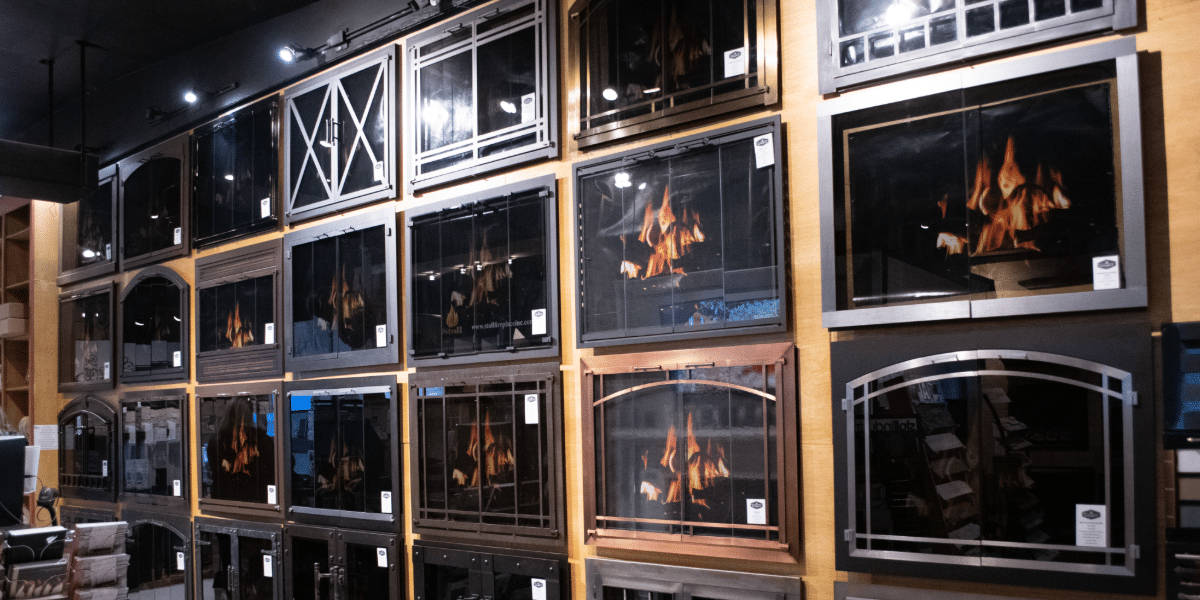
For most buyers, the showroom visit settles the question in fifteen minutes. We have doors mounted on display in both Lisle and Elmhurst, in the major finishes, with the hardware operable. Seeing a Brushed Brass finish next to a Burnished Bronze under the same lighting is the kind of decision the catalog photos can’t quite resolve.
Visit our Lisle or Elmhurst showroom
Visit our Lisle or Elmhurst showroom to see custom fireplace glass doors on display in the major finishes — and have a measure-and-quote conversation with the team that builds the install plan.
Fireplace & Chimney Authority serves homeowners across the full Chicagoland metro — Cook, DuPage, Kane, Kendall, Lake, McHenry, and Will counties.
Lisle Showroom
1702 Ogden Avenue, Lisle, IL 60532
(630) 686-7196
Hours: Tues–Thurs 9AM–6PM, Fri–Sat 9AM–5PM, closed Sunday
Peak season (Oct 15–Jan 31): also open Monday 9AM–6PM
Elmhurst Showroom
120 East Lake Street, Elmhurst, IL 60126
(630) 538-8913
Hours: Tues–Thurs 9AM–6PM, Fri–Sat 9AM–5PM, closed Sunday
Peak season (Oct 15–Jan 31): also open Monday 9AM–6PM
Adam McMahon is President of Fireplace & Chimney Authority, where he has spent 15 years across the hearth, chimney, and outdoor living trade. He started in the field as a technician and has personally installed hundreds of fireplace glass doors over his career. He now oversees sales and install operations across the western suburbs of Chicago and the broader Chicagoland metro, working out of the Lisle and Elmhurst showrooms.
